🎶You might win some, but you really lost one/ You just lost one, it's so silly, how come?/ When it's all done, did you really gain from/ What you done done?/ It's so silly, how come?/ You might win some, but you really lost one/ You just lost one, it's so silly, how come?/ When it's all done, did you really gain from/ What you done done?/ It's so silly, how come?/ You just lost one 🎶
Jay-Z’s Freestyle Just Lost One
Two things can be true at the same damn time. Jay-Z can be an iconic hip-hop rapper from the Marcy Projects in Brooklyn, New York, who now gives back to communities across the globe—including the one he grew up in—in the highest spirit of philanthropy. And be someone who has crossed two Black national boycott picket lines in the 21st century within just six years of each other. Some Black people are choosing to hold him accountable for the latter.
We all know the age-old saying, “To whom much is given, much is required.” This could not be more true for Black American celebrities, entertainers, authors, actresses, actors, and the like.
The unknown, unspoken, but expected add-on to that is: do no harm to your people. It is one of the highest standards to live up to because it comes with no set of exact rules. In fact, we often cannot state what “no harm” is until it happens. It often appears to be something your Blackness is supposed to sense, like whether it’s going to rain outside by smelling the morning air, looking at the clouds, or watching the sway of the tree leaves. It is spiritual in nature and something you are expected to always be connected to. God forbid you violate the rule. You can then be accused of losing touch with your Blackness, choosing to turn your back on it (aka a sellout), or becoming an Uncle Tom. After all, nine times out of ten, it was the support of the Black community that catapulted you to your superstar status, right?
Puppets & Clowns
One thing Black folk gotta commit to as we continue to fight for our collective freedom is to stop looking to entertainers as leaders in the struggle for liberation. That’s not to say that they aren’t a part of it, or can’t show themselves worthy of such an honor, but let’s raise the standard a little higher than millions of social media followers, sold-out shows, blockbuster deals, or anything adjacent to capitalistic admiration. We have true academicians, community organizers, and social justice leaders for that—folks who have shown themselves committed, dedicated, and, most importantly, knowledgeable enough to share information and direct movements.
Time and time again, we see entertainers putting the almighty dollar first. And you know what? Let’s not blame them for that. After all, their job is to entertain us in one form or another, and to get paid to do it. They’ve worked hard and made sacrifices to be known for their craft. This isn’t to say they can’t provide valuable knowledge and information. Of course they can! But entertainers who are social justice warriors, historians, liberators, and freedom fighters aren’t why they are famous and admired, and we’d do well to remember that.
Malcolm X said in an interview, “Show me in the White community where a singer is a White leader or a dancer or trumpet player is a leader. These aren’t leaders, these are puppets and clowns who have been set up over the Black community by the White community and have been made celebrities and usually say exactly what they know the White man wants to hear.”
Puppets and clowns—ultimately, this is what one will be left looking like when they choose their career or a paycheck over cultural taboos. Take Kevin Hart, for example, laughing at a White comedian making a joke about the murder of George Floyd, a historically traumatic moment that lit the match for a global Black Lives Matter movement. Nicki Minaj, Nelly, and Snoop Dogg all performed for the most overtly racist president in modern-day history. And now there’s Jay-Z; he’s got to secure the bag, too. After all, a billionaire can’t seem to have too much money!
Justify
(Insert “Testify” beat here.)
🎶 Before you lock my love away! Before you lock my love away! Jay-Z has to justify! Jay-Z has to justify! 🎶
And it goes a little something like this:
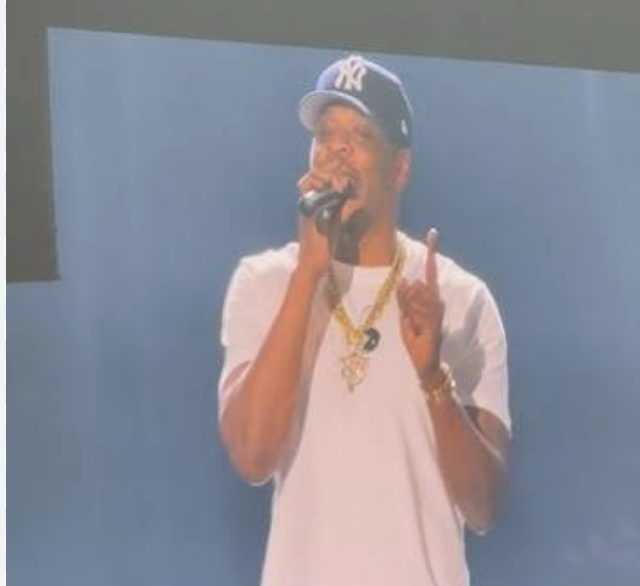
“I’m the target/you aim don’t miss that target/no excuse n*gga/I’m doing what Apple and Walmart did/you shopping at Amazon or you boycotting/you posting on Instagram/that’s meta boy/stop it/y’all know Google owns YouTube/you picking and choosing and politicking as usual/they did a deep scenario/this is embarrassing/they run out of characters/had to bring out the Kap again/buddy took a check/i ain’t even mad at him/but along with that check come a sign of non disparagement/i’m the only one they can’t control/y’all better be glad it’s him/y’all better be glad it’s him/half a billion back in the community/that’s just good math for him.”
On its face, one would say, “Hmm…yeah, Jay, you got a point.”
But what is that point?
That most ordinary, everyday Black people can’t afford to boycott multiple multimillionaire and billionaire corporations?
But they did choose one—Target—because out of all these blood-sucking leeches, Target is the one that played in Black peoples’ faces in public. And Jay-Z is from the hood; he knows what that means (or at least he used to). You’re not allowed to just straight-up disrespect somebody without consequences and repercussions. Why is he acting brand new about this? One can argue he is standing so high up on that mountaintop perch that he is completely disconnected and out of touch. For Jay-Z, money appears to be the motivation—not people, not principles, and certainly not demands that seek to hold a billionaire corporation accountable for profiting off Black promises and racial movements.
Operation Breadbasket
Jay-Z’s criticism of people “picking and choosing” which corporations to boycott may sound persuasive on the surface. But it ignores one of the oldest and most successful organizing strategies in the history of the Black freedom movement: selective patronage.
While Jay-Z’s freestyle points out “picking and choosing,” it overlooks one important connection that the Target Boycott holds true when it comes to strategic organizing. There’s rules to this game, too. One of the most powerful principles implemented during the Civil Rights Movement was called selective patronage. During the early 1960s, Dr. King led what he called “the most successful program of his northern campaign.” The goal was to target specific companies to increase African American employment and negotiate a percentage of hiring increases. If this method failed, the African American community was encouraged to boycott selected stores or products until change occurred. Not every company or product involved in discriminatory practices—specific companies and products. This was a targeted movement. (See what I did there?)
What history shows us is that this collective organizing increased “2,000 new jobs worth $15 million a year in new income to the Black community in the first 15 months of its operation.”
With Target, the numbers are clear. The boycott continues to create significant losses to the company’s reported profits, sales, stock value, and reputation. This movement, spearheaded by three Black womxn in Minnesota, is strategic, collective, and successful. All folks gotta continue to do is ignore the clowns and puppets being paid off to lure Black and Brown people back into the stores. Target has dug its feet into the proverbial sand and is willing to do anything other than stay true to the words it committed to the Black community six years ago.
We don’t expect Jay-Z, or any other entertainer who has crossed the picket line to sign deals with Target, to know the history of successful movements or, for that matter, to care. But make no mistake about it, the Target Boycott is being led by organizers. There is a strategy here, and it is working.
You don’t need to boycott every single company all at once. But the successful boycott of one company can lead to the successful boycott of another. This is how collective power is built. This is why the power is with the people.
So don’t be guilt-ridden by a billionaire’s freestyle into believing that your need to still depend on these corrupt, corporate giants somehow makes you a flake or a hypocrite. Save that for the next entertainer who really “takes the check.” Continue to build and support ground-level movements! This Target Boycott can become the next Operation Breadbasket, and that’s what they are really afraid of.
Tone Deaf
I wasn’t even mad at Jay-Z’s freestyle. In fact, I’m still not. He has a mic, a skill, an audience, and a perspective.
(Insert “This Is America” beat here.)
🎶 Get yo’ money, Black man. Get yo’ money! 🎶
Where his freestyle demonstrated true disconnect and oblivion, though, was his unnecessary aim at Colin Kaepernick. I guess Jay-Z is still feeling the guilt or shame from the first time he busted up a national Black protest and may be struggling to think straight because—read the room, son! Colin Kaepernick is literally in the news right now for paying for yet another independent autopsy of another Black body. This time it’s the body of eighteen-year-old Nolan Xavier Wells, the Black teenager who went out on a boat with his all-White “friends” on the Fourth of July in Mississippi and never came home. If he was going to mention Kaepernick at all, this would have been the perfect time to acknowledge his social justice activism, and continued upliftment and support of Black communities.
Perhaps even a moment of silence for Nolan Xavier Wells.
But why would he do that? Why should he even be expected to do that? Jay-Z is a rapper on tour promoting the 30th anniversary of his first album. So…fine, we won’t hold him to that standard.
But at the very least—do no harm.
🎶 If you look closely you’ll see what you’ve become
‘Cause you might win some, but you just lost one
You might win some, but you just lost one 🎶
—Lauryn Hill, Lost Ones
Sources:
ABOUT THE AUTHOR
Verde Arzu is the Black queer author-publisher of Rainbow (2019) and Promise Keeper (2025). Join the Rainbow Peeps & Friends community by listening to her podcast Verde’s Folding Chair, buying her books, and merch!
Follow: the_writer_verde_arzu
✌️❤️& 🌈🌈