
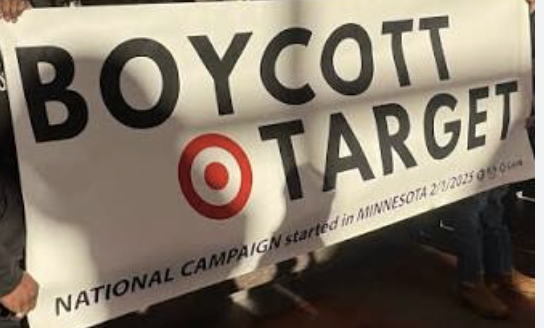
Make no mistake about it: the Target Boycott was spearheaded by Black womxn, and they remain ten toes down and committed to holding Target true to its promises. Dr. Nekima Levy Armstrong, Monique Cullars-Doty, and Jaylani Hussein are three Minnesota organizers who demanded that Black America hold Target accountable to its promises to ensure diversity, equity, and inclusion (DEI) initiatives, which the company implemented after Minneapolis police officers murdered George Floyd in May 2020.
Alongside activists Nina Turner (We Are Somebody) and Tamika Mallory (Until Freedom), these Black women continue to lead a national movement that some sources have reported has resulted in a $20 billion dollar loss in profit by the corporate giant.
Target, headquartered in Minneapolis, Minnesota, promised Black America that it would help its Black employees build careers, improve the experience of Black shoppers, and promote Black-owned businesses. After Target widely publicized its commitment to improving its diversity, equity, and inclusion policies, the company saw record sales.
“On behalf of our entire team, I can promise you that we will stay engaged in this work as a lasting expression of our purpose—both through our enterprise and diversity-and-inclusion strategies, and through our Racial Equity Action and Change Committee, which was created specifically to advance racial equity for Black team members and guests across all areas of Target’s business,” Brian Cornell, former chairman and CEO of Target, wrote in its 2020 Annual Report.
Black America heard Target loud and clear, and support for these efforts was widely accepted within the community. However, in January 2025, under pressure from the Trump administration, Target broke these promises and publicly ended its diversity, equity, and inclusion programs. Black America heard that, too. The deceit and betrayal felt by Black Americans were palpable and evident in their collective nationwide boycott efforts.
Divide and Conquer
After the launch of the Target Boycott, Pastor Jamal Bryant, a megachurch pastor based in Atlanta, joined the movement. Bryant’s self-proclaimed “Target Fast” became a branch for continued mobilization. In doing so, Bryant encouraged those participating in Lent to withhold shopping at Target for forty days and to spend their money with Black-owned businesses instead.
Without correction from Bryant, American media outlets immediately proclaimed him the face and leader of the movement. So when Bryant attended a press conference on March 11, 2026, in Washington, D.C., after meeting with Target CEO Michael Fiddelke to end the “Target Fast,” Black America was shocked and confused, especially since, in response to the press conference announcement, organizers in Minnesota stepped up to proclaim that this was not the case. Dr. Nekima Levy Armstrong appeared on Roland Martin Unfiltered on March 16, 2026, to address the confusion.
“Number one, the Target Boycott is still going on. As a matter of fact, double down. Number two, if people want to organize within their community, whether it’s a demonstration outside of Target, in Target, letter writing…please do that! People know how to participate and they have been. My problem comes in when you have people positioning themselves as leaders who have a completely different agenda to coop, to cause confusion, to call off a successful boycott–why are you involved?”
From the outside looking in, Bryant’s pivot, which did not include Minnesota organizers, reverberated across Black communities as a sellout moment. Before the national press conference attended by Bryant, alongside Turner and Mallory, there was never a public moment in which he clearly addressed a distinction between the Target Boycott and the religious “Target Fast” he initiated from his pulpit. After the press conference, media outlets across the country headlined that Bryant was calling an end to the Target Boycott, creating confusion and division.
Dr. Armstrong argued, “If the Target Boycott wasn’t successful, you wouldn’t have a divide and conquer strategy where they are sitting here meeting with White leadership from Target, calling for an end to the Boycott, and nothing to show for our community.”
The aftermath of this decision left many within the Black community wondering: What did Target guarantee Bryant, personally, that encouraged him to end his religious fast? Notably, the commitments Bryant highlighted during his March 11 press conference did not address the six demands published on NationalTargetBoycott.com.
Further, even as a branch and offshoot of the Target Boycott, why hold a press conference in Washington, D.C. instead of where you began the fast, in the pulpit of his church? It can easily be concluded that people participating in and standing in solidarity with the Target Boycott viewed Jamal Bryant’s support as part of the same movement, not as a separate effort.
That is why the March 11 press conference was perceived by many as an act of sabotage and deceit, especially since Bryant held no formal authority to speak for, negotiate on behalf of, or call an end to the broader Target Boycott.
The Movement Continues
As history teaches us, movements are not smooth and easy. Leaders disagree, and division can and does happen within organizations. The philosophical differences about the way forward that we are bearing witness to within this Target Boycott are not extraordinary. As we have learned from the past, let us learn from these moments as well, allow them to strengthen us, and continue along in the fight for justice and freedom.
One thing Dr. Nekima Levy Armstrong makes clear in her interview with Roland Martin Unfiltered, as well as on NationalTargetBoycott.com, is this: Target must meet six demands:
- Restore and strengthen DEI commitments.
- Ice Out: Publicly Oppose the ICE Surge.
- Community Engagement & Transparency.
- End Corporate Complicity in Racialized Surveillance.
- Protect Constitutional Rights: 4th Amendment Policy.
- Due Process and Justice: Free Mahdi Ali.
Today is July 15, 2026, and Target has yet to meet these demands. Therefore, until Target meets these demands, the Target Boycott continues.
Sources:
- https://nationaltargetboycott.com/
- https://www.youtube.com/watch?v=QskRSZLYvOI
- https://www.youtube.com/watch?v=gOD9PCUVtt8
- https://thegrio.com/2026/03/20/heres-what-nina-turner-and-tamika-mallory-say-is-next-for-the-target-boycott-and-lessons-learned/
- https://corporate.target.com/investors/annual/2020-annual-report?utm_source=chatgpt.com
- https://corporate.target.com/news-features/article/2021/07/workforce-diversity-report?utm_source=chatgpt.com
- https://www.mprnews.org/story/2026/03/11/target-dei-boycott-founders-say-consumer-protest-still-ongoing
- https://www.reddit.com/r/minnesota/comments/1rrsg21/the_star_tribune_knowingly_published_a_bogus/
ABOUT THE AUTHOR
Verde Arzu is the Black queer author-publisher of Rainbow (2019) and Promise Keeper (2025). Join the Rainbow Peeps & Friends community by listening to her podcast Verde’s Folding Chair, buying her books, and merch!
Follow: the_writer_verde_arzu
✌️❤️& 🌈🌈